Can't Do a Push-Up Yet? Wall, Knees, Then a Game That Counts Them
Can't do a push-up yet? Lift less of yourself: hands on a wall, then a counter, then the stairs, then the floor on your knees, then on your toes. Take the next step when every push-up looks like the first. From the knees on, Push Flight, a game in SWADE, counts them: knee push-ups count the same.
In this guide
- Can't do a push-up yet? Lift less of yourself
- Why a push-up feels out of reach
- A push-up progression from zero, in five steps
- What makes it a push-up, on every step
- When you're ready for the next step
- Knee push-ups: a real push-up, done right
- Can't do knee push-ups either? Three ways in
- Which step are you on?
- Push Flight: from your knees on, a game counts them
- Your camera stays on your phone
- What this guide doesn't cover
- Frequently asked questions
Can't do a push-up yet? Lift less of yourself
A floor push-up asks a lot at once: your arms lower and lift a big share of your body while the rest of you holds a straight plank. Too much today? Lift less of yourself: raise your hands, or put your knees down, and the same move gets lighter.
That isn't gym folklore. In a 2011 study, 23 recreationally fit people, 14 men and 9 women, did six push-up variations on a force plate. With their hands raised on a box, or from their knees, the plate measured less force than in a regular push-up; with their feet raised, more. The study found no significant difference between the men and the women in how the variations compared. It didn't test a wall: a wall push-up just takes the same idea further.
So the plan is a ladder, from the wall to the floor, with no numbers to hit: how many you do depends on you, and on the day. On October 20, 2026, Google completed "can't do a push up" with "where to start", and "I can't do a push up" with "how do I start"; for "push ups for beginners", it offered "female" and "male" versions. The ladder answers the first two, and it's the same for everyone: where you start depends on what you can do today, not on who you are.
Why a push-up feels out of reach
Knowing what's missing tells you what to work on.
- The bottom. You can lower yourself, but pushing back up won't happen. Work on it with slow lowerings and short presses from the floor (see "Three ways in", below).
- The line. A push-up moves your whole body as one piece: if your hips sag or stick up, it falls apart before your arms give out. A plank on straight arms trains that line.
- Pain. If your wrists, elbows or shoulders hurt when you push, or your knees when you kneel, stop and ask a doctor first. Sorting out pain isn't a guide's job.
Used to do push-ups, and can't now? The ladder works the same way: start on the step where your form holds today, not where you used to be. If it came on suddenly, or with pain, see a doctor first.
A push-up progression from zero, in five steps
Each step is the same push-up with more of your weight on your hands. Here's the ladder, easiest first; the stairs and the knees can swap.
| Step | Hands on | Body | To make it a little harder |
|---|---|---|---|
| 1. Wall push-up | A wall, about shoulder height | Standing, feet back, leaning in | Step your feet further from the wall |
| 2. Counter push-up | A kitchen counter or a sturdy desk | One straight line, head to heels | Walk your feet further back |
| 3. Low incline | A sturdy bench or the stairs | One straight line, head to heels | On the stairs, go one stair lower |
| 4. Knee push-up | The floor, under your shoulders | Knees down, one straight line, head to knees | Set your knees a little further back |
| 5. Floor push-up | The floor, under your shoulders | On your toes, one straight line, head to heels | You're there: now keep every one clean |
Sources, read October 20, 2026: Google Suggest completions in English for "can't do a push up", "I can't do a push up" and "push ups for beginners"; Ebben and colleagues, "Kinetic analysis of several variations of push-ups", Journal of Strength and Conditioning Research, October 2011, abstract on PubMed. Google, iPhone and Android are trademarks of their respective owners. SWADE is independent and is not affiliated with, sponsored or endorsed by any of them.
Whatever your hands are on must not move: no rolling chair, no wobbly table, no mat sliding on tiles.
You don't need every step. Some people go wall, knees, floor; others skip the knees and go from the stairs straight to their toes. Start on the step where you can do a few clean push-ups, and work there.
What makes it a push-up, on every step
Wall or floor, the same three checks make a push-up a push-up. Use them to judge your own.
- One straight line. From your head to your heels, or to your knees. Hips don't sag toward the floor and don't stick up.
- Elbows bend, chest goes down. Toward the wall, the counter or the floor, as low as you can control, hands in line with your shoulders.
- All the way back up. Arms straight at the top before the next one starts.
Keep breathing as you go: in on the way down, out on the way up. A counter push-up that passes all three checks is a better step than a floor push-up with your hips in the air.
No coach to check? Do a few side-on to a mirror, or prop your phone up, film one try and watch it back: a sagging back is easier to see than to feel. Or let an app keep the count: our guide to push-up counter apps compares how they decide what counts.
When you're ready for the next step
No rep count decides it. Your form does. Take the next step when all three are true:
- Every push-up looks like the first: same line, same depth, all the way back up.
- The last ones are hard, but still clean. If your form breaks before the end, stay on this step.
- It isn't a one-off. It feels that way on more than one day, not only on a good one.
Taking the next step doesn't mean leaving the last one behind. Do your first few on the new step, while you're fresh, and finish on the one you know. On a bad day, go back a step: it's still a push-up.
Knee push-ups: a real push-up, done right
Knee push-ups get looked down on. They shouldn't: it's the same move with less of your weight on your hands, and it's a push-up as long as it passes the three checks.
How to set up
- Knees on a mat or a folded towel.
- Hands on the floor under your shoulders.
- Walk your hands forward, or your knees back, until your body makes one line from your head to your knees.
- Lower your chest between your hands, then push back up to straight arms.
A common slip: hips left back over the knees, bottom in the air. That turns it into a smaller, different move. Hips forward, in line. If kneeling hurts, stop there and ask a doctor first.
Knees or an incline first?
Both make a push-up lighter. An incline keeps the line of a floor push-up, head to heels; knees put your hands on the floor and shorten the line. Neither order is the right one: try both, and keep the one where your form holds.
From knees to toes
Same rule as every step. Once your knee push-ups pass the checks on more than one day, open each practice with a few tries on your toes, then finish on your knees. None on your toes yet? Lower yourself slowly from a plank on your toes instead.
Can't do knee push-ups either? Three ways in
Then start a little higher, or work on the part that's missing.
- Go back a step or two. A counter or a wall. That isn't failing: it's the same push-up, lighter.
- Lower slowly, then press. Start at the top of a knee push-up and lower yourself as slowly as you can control, all the way down: it's called a negative. From the floor, press up as far as you can, even a little, then get up the rest of the way any way you like. Together, they work on the push from the bottom.
- Hold the top. A plank on straight arms, on your knees or your toes, held still. It's where every push-up starts, and it teaches the straight line.
If any of these hurts, stop, and see a doctor first.
Which step are you on?
| Your situation | Start here | Why |
|---|---|---|
| You've never done a push-up | Wall push-ups | You learn the line before the weight |
| Wall push-ups feel easy | A counter, then the stairs | Same line, a bit more of you on your hands |
| Knee push-ups, yes; toes, not yet | Knees, with your first tries on your toes | You practice the step you're after |
| You can lower yourself, not push back up | Slow lowerings, then short presses | You work on the push from the bottom |
| Counting bores you | Push Flight, from the knee step on | The game keeps the count, and a record waits |
| Your wrists, shoulders or knees hurt | A doctor first | A guide doesn't replace medical advice |
| You're under 15 | Not SWADE | SWADE is made for players aged 15 and up |
Push Flight: from your knees on, a game counts them
SWADE is a fitness game app, coming soon to iPhone and Android: prop up your phone and its camera turns your moves into the controller. Push Flight, its second game, runs on push-ups. Here's where it sits on the ladder.
| Step | In Push Flight |
|---|---|
| Wall push-up | Not part of the game: it's how you get there |
| Counter or low incline | Not part of the game either |
| Knee push-up | Counts: same score, same records |
| Floor push-up | Counts |
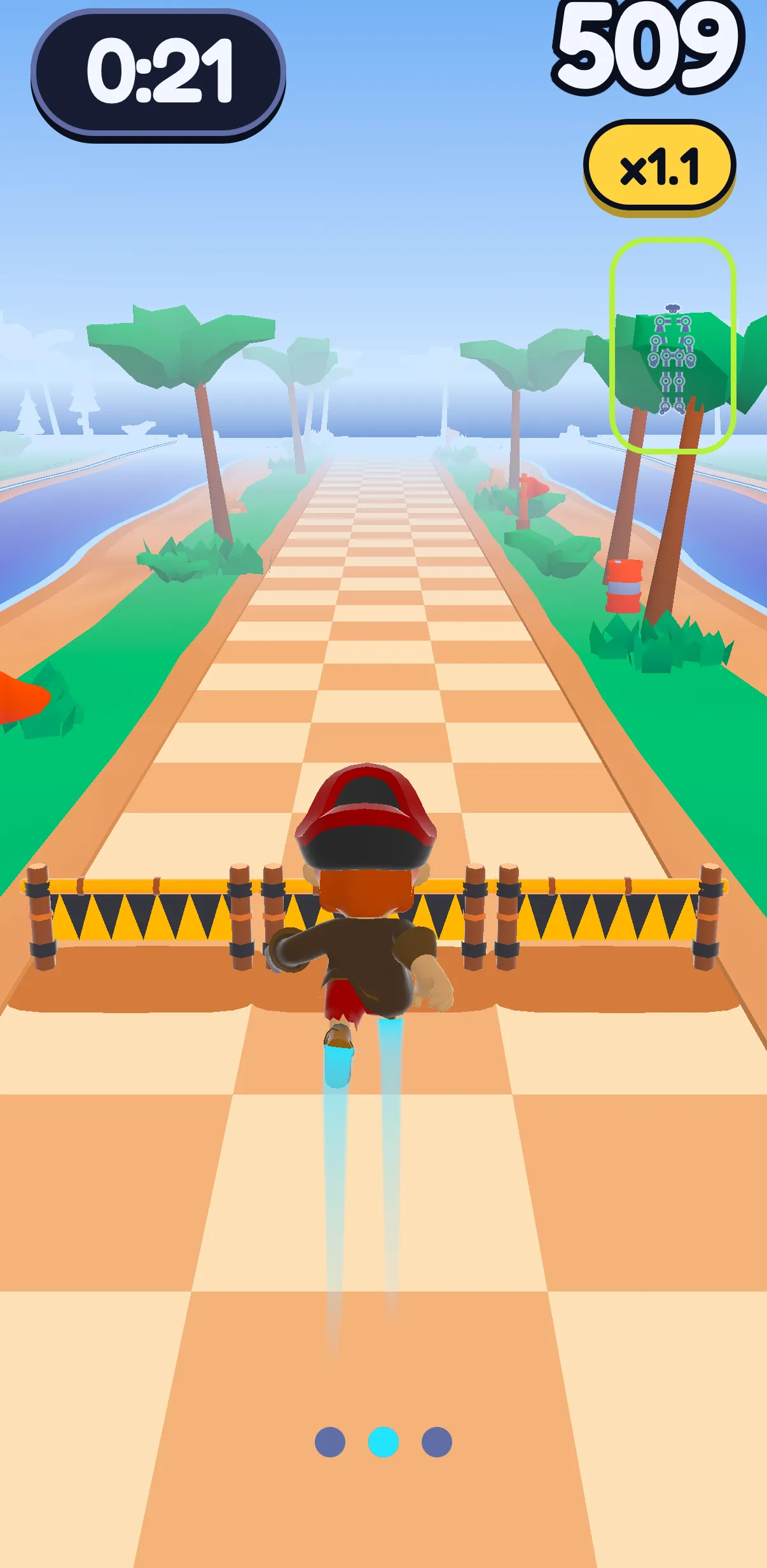
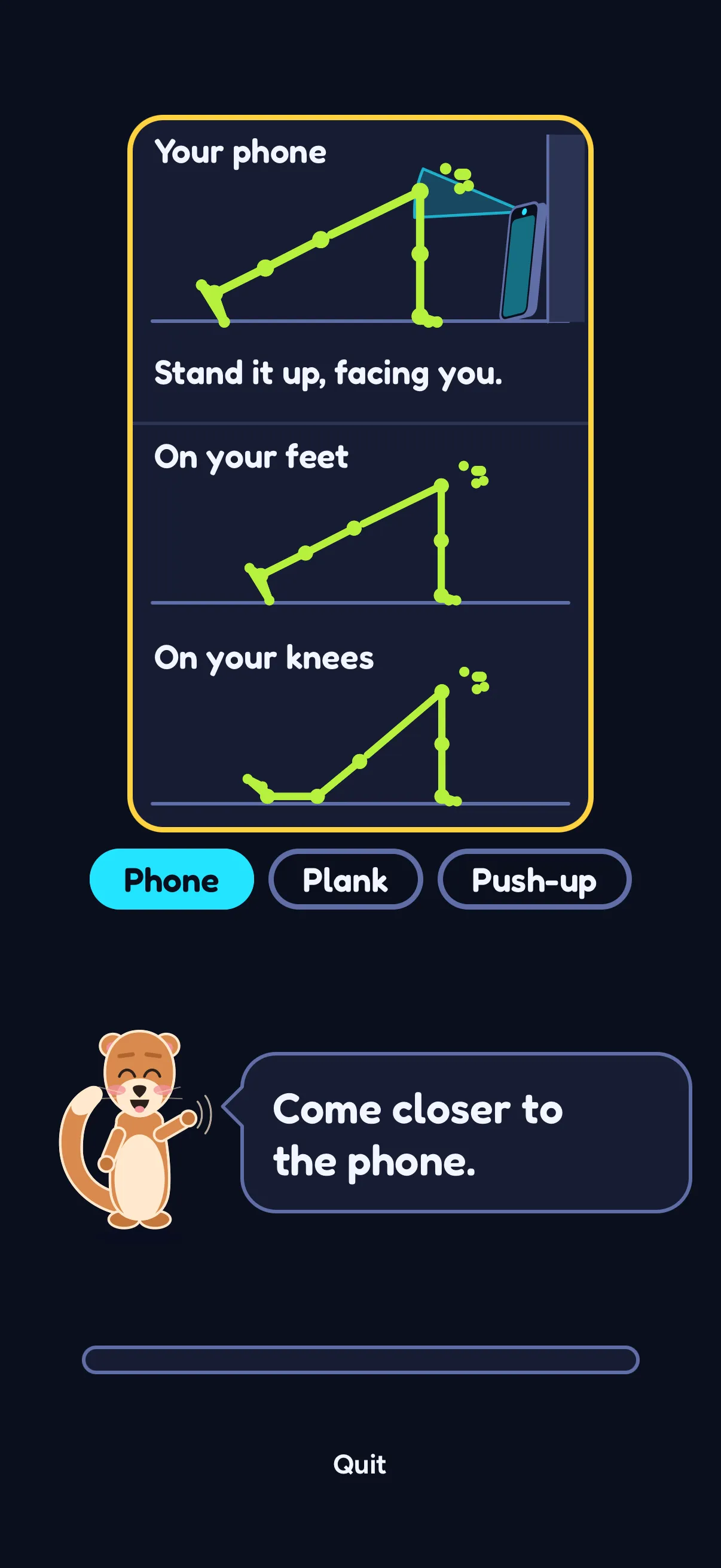
Where you play. In a plank on the floor, facing your phone, which stands upright with a wall or a box behind it: lying flat, it would see nothing but the ceiling. The game's setup shows two positions, on your feet and on your knees. Sway, SWADE's weasel, wears a jetpack, and your head sets how high Sway flies through the gates.
What it asks first. The setup has three parts, Phone, Plank and Push-up: once the camera sees your head, shoulders and wrists, keep your plank steady, then do one full push-up, on your feet or your knees. That one is a check, and it stays out of your total. Stop short and Sway says "Go lower!"; keep stopping short and, unless you told SWADE to go easy on your knees, Sway offers "Knees down? That's fine!" instead. Then a short countdown with your arms straight, and your next push-up takes off ("One push-up, take off!"). That one counts.
Not there yet? If one full push-up on your knees is still out of reach, the game won't start, and that's fair: give the wall and the stairs a little longer.
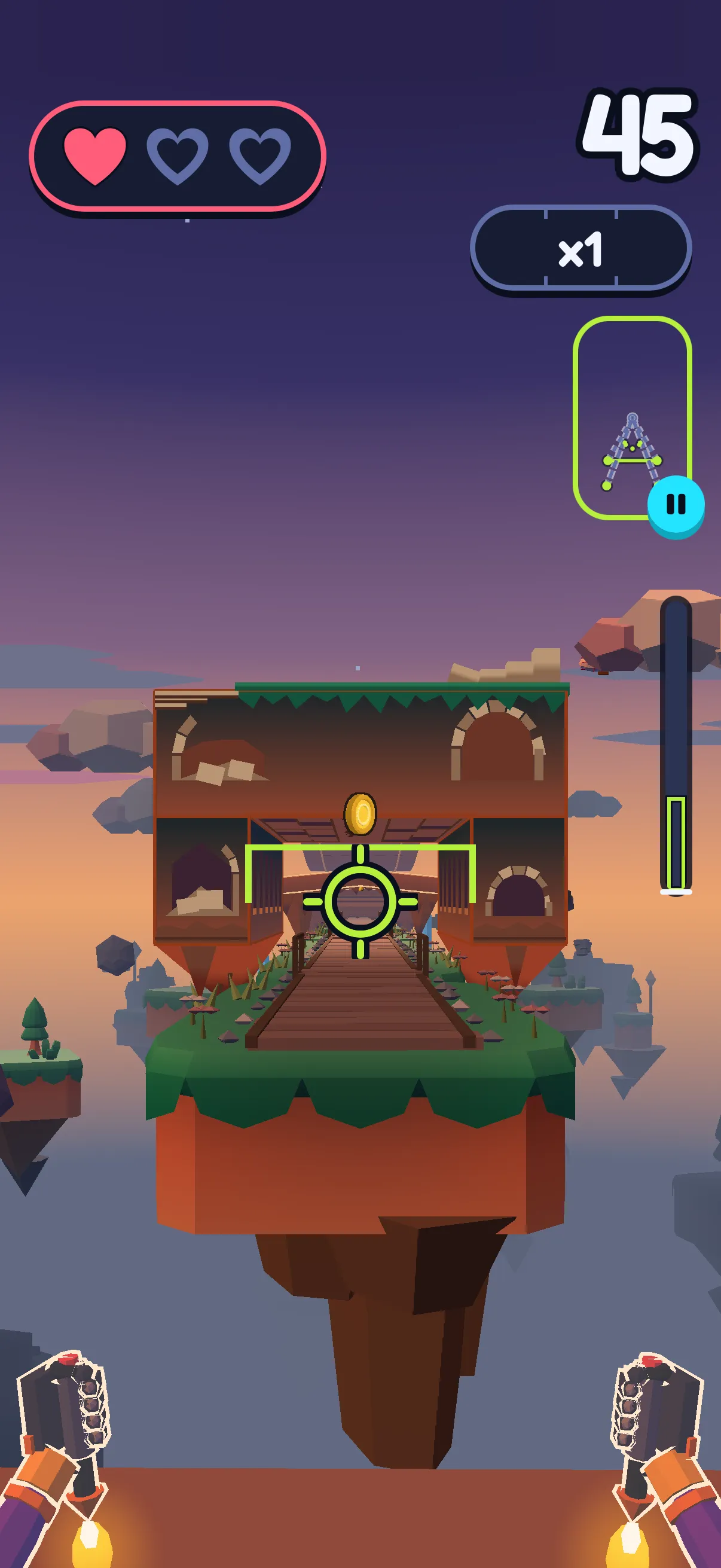
What counts once you fly. Your shoulders: all the way down is one push-up, higher is part of one, and the parts add up. Straight arms never count ("Bend your elbows! That doesn't count."), and neither does a nod. Your total comes when the game ends, rounded down, and adds to the This month card on your Profile.
Made for a slow start.
- Your first game is a guided warm-up: slow, wide gates, easy coins, no hearts, and no energy spent.
- After that, you pick your level before each game: Beginner, Intermediate or Advanced.
- In Timed, you can't crash out, and slower push-ups mean a slower flight.
- Now and then Sway calls "Breathe!": nothing to dodge, so you can rest at the top, arms straight.
What it doesn't do. No plan to your first push-up, no sets, no daily target, and no coaching beyond how low your shoulders go and whether your elbows bend. It lives in the Play tab, not on the daily Path: each game costs one energy, which comes back over time, and the warm-up costs none.
Your camera stays on your phone
In SWADE, the camera and the pose tracking run on your phone: no image, no video, not one frame leaves it. What travels is the result of a game: a score, your push-ups. Two exceptions, only while "Help improve SWADE" is on, as it is at first: a few numbers on how the camera followed you in Push Flight, and now and then a short sample of your moves drawn as a stick figure of 33 points, never an image, sent over Wi-Fi only, with no account attached. You can switch it off in Settings. Our servers are in the EU. Details in the privacy policy.
What this guide doesn't cover
- How long it takes. It depends on you, so there's no date here.
- Sets, reps and schedules. No numbers here: a coach who knows you can set them.
- Pain, an injury, pregnancy or a recent operation. A doctor first.
- Muscles, calories and weight. We don't talk about them here.
- A whole beginner program. This guide is about one move; for apps that plan full workouts, see our guide to workout apps for beginners.
Frequently asked questions
Why can't I do a single push-up?
A floor push-up asks a lot at once: your arms lift a big share of your weight while your body holds a straight plank. It's a starting point, not a verdict. Raise your hands on a wall, a counter or a stair, or put your knees down, and work your way to the floor. The same goes if you could do push-ups before and can't now. If it hurts, or came on suddenly, see a doctor first.
Do knee push-ups count as real push-ups?
Yes. It's the same move with less of your weight on your hands, as long as your body makes one line from head to knees, your chest goes down and your arms straighten at the top. In SWADE's Push Flight, they count like any other push-up, for the same records.
What should I do if I can't do knee push-ups?
Go back to an incline: a wall, a counter or a stair. You can also lower yourself slowly from the top of a knee push-up, then press up from the floor as far as you can, or hold a plank on straight arms to learn the line.
How long does it take to do your first push-up?
It depends on you: where you start, how often you practice, how you feel on the day. So this guide gives no date. Take the next step when the checks pass, not when a calendar says so.
Can I play Push Flight if I can't do a push-up yet?
Yes, once you can do one full push-up on your knees: the game asks for one before you fly, and a half doesn't pass. That one is a check and isn't counted; from the next one on, push-ups count, a shallower one for part of one. Wall and incline push-ups aren't part of the game: they're how you get there.
Is SWADE free?
Yes. The day's session is free, with XP and your streak. Playing more spends energy, which refills over time. Premium is optional: unlimited energy and unlimited day savers, and the yearly plan starts with a 14-day free trial. Push Flight is played from Play, so each game spends one energy; your first, a guided warm-up, is free.